
If your salt system stopped making chlorine the week a cold front came through, the cell is probably fine. Pentair, Hayward and Jandy all build a low-temperature cutoff into their chlorinators: when the water gets down to around 50°F, the cell switches itself off, and it comes back on by itself when the water warms up. Hayward's starts cutting output back at 60°F. Here's where each brand draws the line, what its panel shows when it does, and how to tell a cold-water shutdown from a cell that's actually failing, from the manufacturers' own manuals.
Redzone Pools repairs Pentair, Hayward and Jandy salt systems across Cypress, Tomball, Katy, Spring and Greater Houston — licensed, insured, usually same day.
A salt cell's low-temperature cutoff is a built-in setting that stops chlorine production when the pool water gets too cold, to protect the cell. It isn't an error and there's nothing to reset: production starts again on its own once the water warms back up.
The manufacturers say why. Pentair says its IntelliChlor cutoff extends the life of the cell. Jandy warns that running an AquaPure around the clock through the winter in extremely cold water can affect cell life, and that it's sometimes necessary to run it at 10–20% or turn it off. And all three make the same point about demand: cold water needs very little chlorine. Pentair adds a condition, as long as free chlorine stays at 2.0–4.0 ppm, while Jandy and Hayward both warn that running the chlorinator as normal in cold water can over-chlorinate the pool.
The three brands don't share a threshold or a display, which is why the advice online contradicts itself. This is what each manufacturer's own documentation says:
| Salt system | When it stops | What you'll see | Override |
|---|---|---|---|
| Pentair IntelliChlor | Switches off at 52°F, give or take 3°F | Newer units: the COLD WATER light turns red and every other light goes off ("Standby"). Older units without that light: the CELL light goes dark | None described in Pentair's guides; it waits for the water to warm above 52°F |
| Hayward AquaRite | Output is cut back to 20% of your setting at 60°F and stops at 50°F | The display reads COLD and the GENERATING light flashes | Switch to SUPER CHLORINATE for a day |
| Jandy AquaPure | Production isn't permitted below 51°F (11°C) | The display shows "Lo" and the CELL ON indicator stays off | BOOST (hold the pool temperature/Boost button for 10 seconds) runs 24 hours at 100% |
Pentair's tolerance matters. At 3°F either way, an IntelliChlor can go into standby with the water at 55°F, or keep running down to 49°F. Its standby looks alarming, too: on current models every light except COLD WATER goes out, which is easy to mistake for a dead unit.
Hayward slows down before it stops. It's the only one of the three whose documentation describes a gradual cutback. Hayward's AquaRite diagnostics manual says output is scaled back to 20% of the dial setting at 60°F, so in the high 50s an AquaRite can be making far less chlorine than its dial suggests. Its operating range is 50°F to 140°F.
Jandy gives two numbers. The same AquaPure manual that puts the cutoff at 51°F in its winterizing section lists the "Lo" code as pool temperature below 54°F (12.2°C) in its code table, so expect it somewhere in that band.
Houston doesn't stay cold; it swings. The National Weather Service's 1991–2020 normals for Houston Hobby put a typical January day between about 46°F and 64°F, with December and February only a few degrees milder. Water changes temperature more slowly than air, but a run of nights like that pulls it down into the range where these cells slow and stop, and a few warm afternoons after a front can bring it back up.
So a cell can switch off after one front, come back on a few days later and switch off again after the next. Lights that go dark and come back are exactly what convinces people a cell is dying, which is why we check the water temperature before we condemn a cell.
On the coldest nights your automation may run the pump for freeze protection, and that doesn't make chlorine either. Pentair's EasyTouch manual says IntelliChlor won't operate or produce chlorine while the filter pump is running in freeze protection mode. Hayward's ProLogic manual says the chlorinator won't operate if freeze protection is the only reason the pump is running. Freeze protection goes by the air temperature, not the water's, so this can happen even when the water is still above the cell's cutoff.
A pump humming all night through a cold snap tells you nothing about chlorine. If a cold stretch drags on, test the water and add chlorine by hand when it drops. Our hard freeze playbook covers the rest of the pad, and our guide to freeze protection settings shows where each brand's setting lives.
The cutoff only explains a cell that stops when the water really is cold. It's time to look further when:
Before you buy a new cell, see what salt cell replacement costs in Houston. If you'd rather we take a look, our salt system repair visit checks the temperature reading, flow, salt and the cell itself.
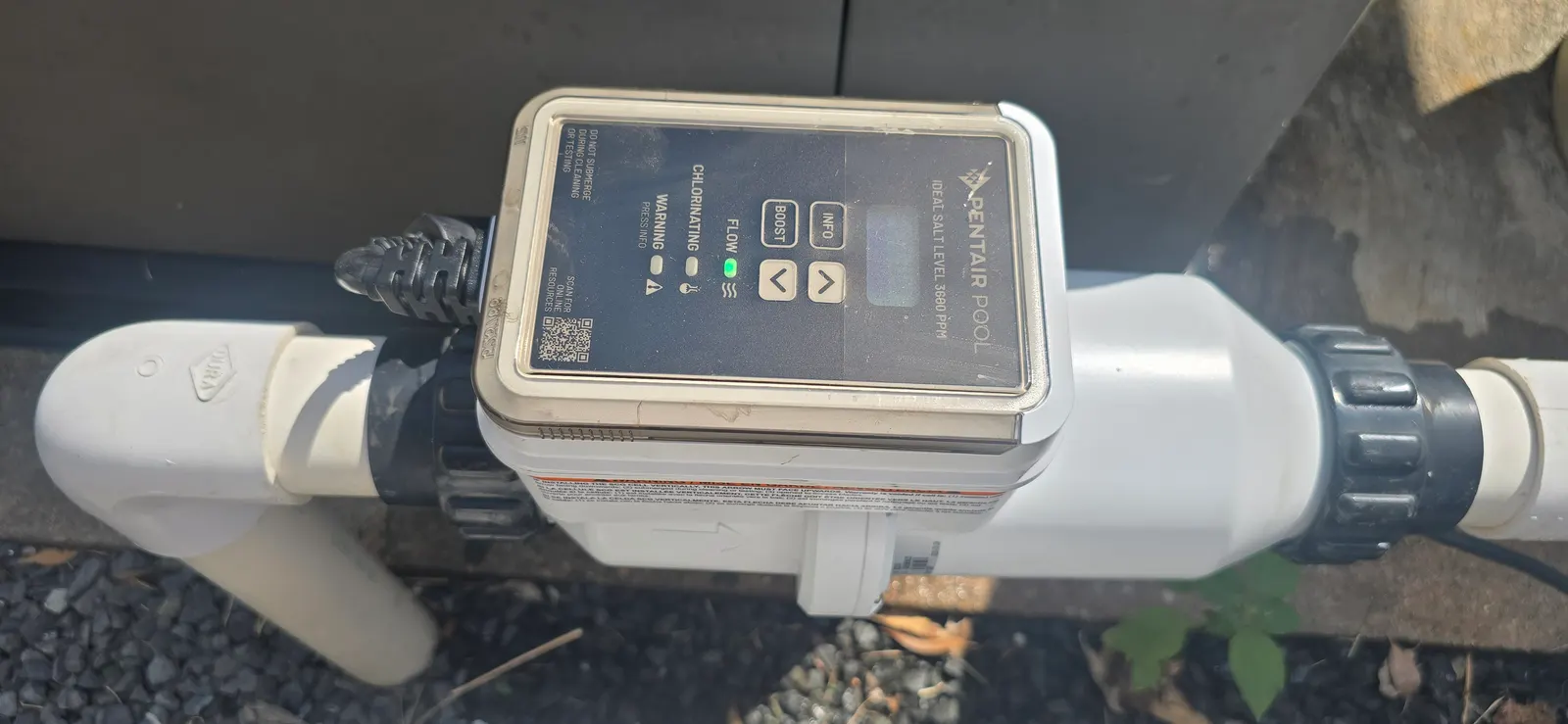
Most likely its low-temperature cutoff. Pentair's IntelliChlor switches off at 52°F, give or take 3°F; Hayward's AquaRite cuts output to 20% of its setting at 60°F and stops at 50°F; and Jandy's AquaPure doesn't allow production below 51°F. Nothing needs resetting: the cell starts again when the water warms.
It depends on the brand. Pentair IntelliChlor: 52°F, give or take 3°F. Hayward AquaRite: 50°F, after cutting back to 20% of its setting at 60°F. Jandy AquaPure: 51°F in its winterizing section, with the manual's code table giving 54°F for its "Lo" code. Check your own model's manual, because the brands don't agree.
You don't have to, because the cutoff switches it off when the water is too cold. Turn the output down instead: Hayward and Jandy both warn that cold water can over-chlorinate, and Jandy says an AquaPure running around the clock through the winter sometimes needs to run at 10–20% or be turned off to protect the cell. Keep testing, and keep free chlorine at the 2.0–4.0 ppm Pentair recommends.
It can. Pentair says an IntelliChlor goes back to normal operation, including an accurate salinity report, once the water warms above 52°F, so don't add salt because of a reading taken in cold water. Confirm it with a separate salt test first.
Use the override if your system has one: Super Chlorinate for a day on a Hayward AquaRite, or Boost, which runs 24 hours at 100%, on a Jandy AquaPure. Pentair's guides don't describe an override for IntelliChlor, so add chlorine by hand. On Pentair EasyTouch and Hayward ProLogic systems, freeze protection runs the pump without running the cell, so a running pump doesn't mean chlorine is being made.
Tell us which salt system you have, what the panel shows and how warm the water is. If it's the cold-water cutoff, we'll tell you so. If it's the sensor, the flow or the cell, we'll fix it. Licensed, insured, serving Cypress and Greater Houston.