
The pump is humming, water is moving in the pool, and the salt system insists there's no flow. It isn't lying, and the switch usually isn't broken. A flow switch doesn't ask whether water is moving — it asks whether enough water is moving, and on a variable-speed pump set to save energy, the honest answer is often no. Here's the mechanism, the minimum each brand actually needs, and the order to check things in.
Redzone Pools services salt systems and variable-speed pumps across Cypress, Tomball, Katy, Spring and Greater Houston — licensed, insured, usually same day.
Every salt chlorinator has a flow switch, and it exists for one reason: a cell that's energized without water passing through it is a safety problem, so the control refuses to generate until the switch says water is moving. The switch is a mechanical device with a threshold. Below a certain flow it stays open, and the control reports No Flow — regardless of what the pump is doing.
Hayward publishes that threshold for the AquaRite: the flow switch requires a minimum flow rate of 11 gpm to stay closed consistently. Pentair's IntelliChlor is designed to operate at 25 gpm, give or take 5, up to 105 gpm, with an internal flow sensor that shuts production off below that.
Now the variable-speed part. A variable-speed pump moves less water at lower speed — that's the entire point of it, and it's where the energy savings come from. A pump programmed for a long, slow, cheap filtration run can move plenty of water for filtration and still fall under the salt system's threshold. Meanwhile the pump is audibly running, the returns are moving, and the box says No Flow. Nothing is broken. The schedule and the switch simply disagree about what "enough" means.
That's why this is a permanent, year-round call for us rather than a seasonal one: the pump was set up to save money, and it does — it just wasn't set up with the chlorinator's minimum in mind. The fix is a schedule, not a part.
These two are from the manufacturers' own installation and diagnostics manuals. They aren't interchangeable, and the difference between them is the difference between a schedule that works on one pad and fails on the next.
| System | Minimum flow | Plumbing the switch wants | What the light does |
|---|---|---|---|
| Hayward AquaRite (separate inline flow switch) | 11 gpm to stay closed consistently | 12 inches of straight pipe before the switch; no elbow after it; installed with the arrow in the direction of flow | No Flow flashes for up to 60 seconds on start-up, then goes out. Stays on when the control can't read the switch at all. |
| Pentair IntelliChlor (flow sensor built into the cell) | 25 ± 5 gpm; up to 105 gpm, bypass loop required over 80 | 12–18 inches of straight pipe in front of the cell inlet; cell no closer than 3 feet from a heater outlet | Flow light red = insufficient flow, no chlorine being produced; green = sufficient. |
Two things jump out. First, the IntelliChlor wants roughly twice the flow an AquaRite does — a pump speed that keeps a Hayward happy can leave a Pentair red. Second, both manufacturers ask for a run of straight pipe ahead of the switch. Turbulence right after an elbow or valve can trip a switch that has plenty of flow on paper, which is one reason two pads with identical pumps behave differently. Jandy publishes its own figure in the AquaPure manual; we haven't reproduced it here because we haven't verified it.
The Hayward start-up behavior deserves its own sentence, because it generates a lot of needless worry: a No Flow light flashing for the first minute after the pump starts is normal. Hayward's manual says to give it 60 seconds. If it's still flashing after that, the switch isn't seeing enough water; if it's on solid rather than flashing, the control isn't seeing the switch — a plug, wire or switch problem rather than a flow problem.
The diagnostic is almost embarrassingly simple. With the salt system showing No Flow and the pump running on its normal schedule, raise the pump speed — a high-speed step or a manual override on the pump's own panel — and wait a minute. If the No Flow light goes out, the switch is fine and the schedule was under the minimum. If it stays on at full speed, the flow is being blocked somewhere, or the switch itself has a problem, and you move to the next section.
The fix, when it's the schedule, is to program the pump so that it runs at a speed above the chlorinator's minimum for the hours the salt system is expected to generate. The rest of the day can still run slow; that's where the savings live. Most variable-speed pumps let you set several speeds against a daily timer, and the salt system only needs the fast step to cover its generating window — the chlorinator produces as a percentage of the pump's run time, so a shorter fast window with the output percentage adjusted upward is the usual shape of the solution.
What you give up in electricity for a few hours at higher speed is small next to a pool that goes green because the cell never ran. If you're weighing that trade, the numbers are in our guide to cutting your pool energy bill with a variable-speed pump; the honest version is that a variable-speed pump saves money at low speed and still has to make its minimums.
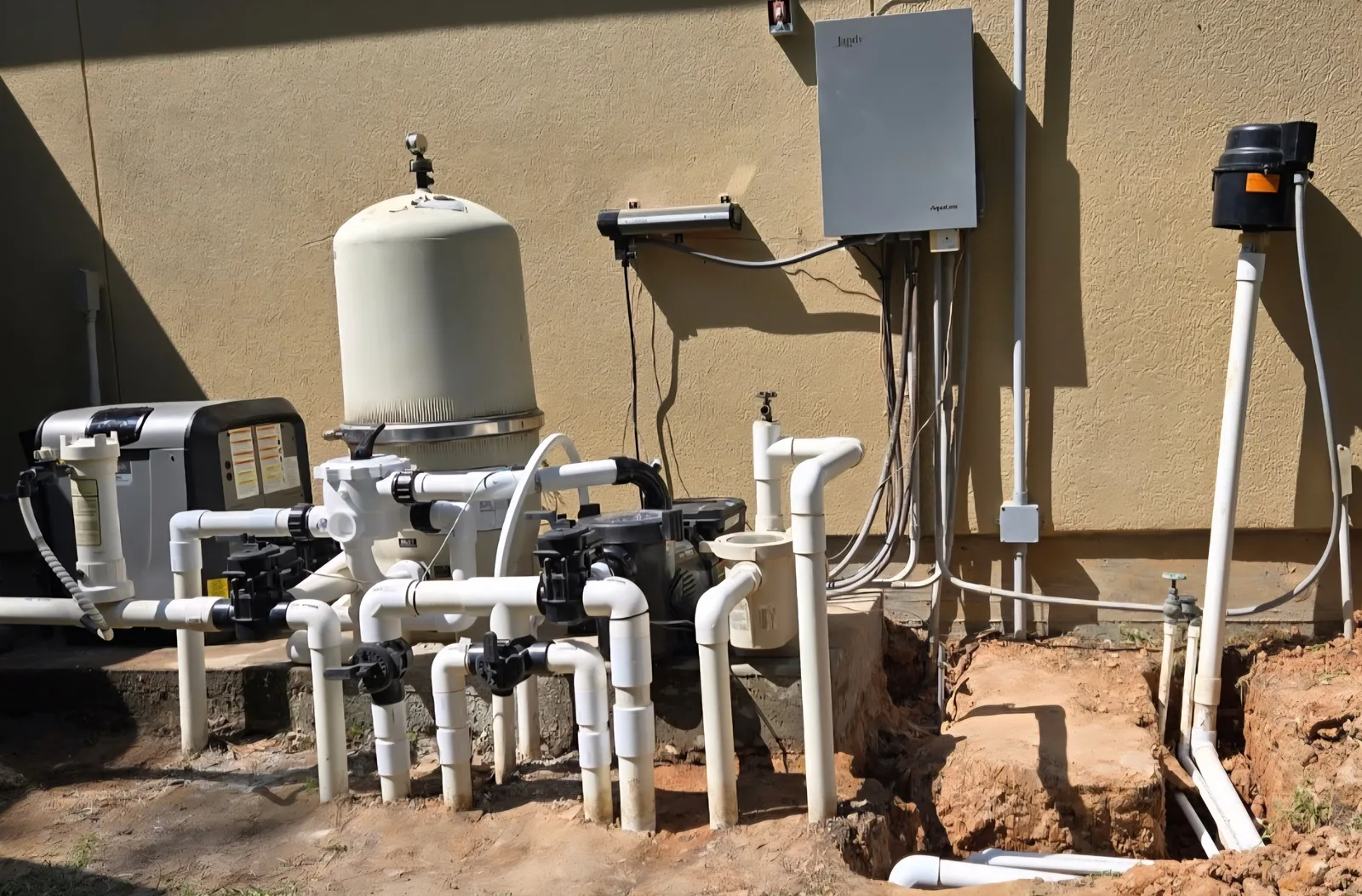
When the light stays on at full speed, work upstream to downstream. Everything ahead of the switch that restricts flow counts, because the switch only sees what arrives at it.
Notice that only the last two items are about the switch, and only the very last is a part. That order isn't an accident; it's how we avoid selling flow switches to people whose filter needed cleaning.
The same logic runs a heater. A Hayward H-Series heater reports LO when its water pressure switch is open, and Hayward's own troubleshooting checks flow above the heater's minimum before it touches the switch — the details are in our Hayward H-Series error code guide. A pump schedule set under the salt system's minimum is frequently under the heater's as well.
Reasonable to do yourself: the pump-speed test; baskets, filter cleaning and valve positions; waiting out Hayward's 60-second start-up flash; reading which lights are on; reprogramming the pump schedule if you're comfortable with its panel.
Stop and call: a light that stays on at full speed after the flow path is clean, a switch that needs re-plumbing, wiring or connector damage, or any question of the control board. Sorting the switch from the schedule from the board is part of our salt system repair service, and we'll set the pump schedule to clear the chlorinator's minimum while we're there.
If the light you're looking at isn't No Flow at all, the other AquaRite lights are decoded in our AquaRite Inspect Cell light guide, and the Pentair panel in the IntelliChlor inspect-cell light. And if the pool is already turning, the sequence for getting the water back is in salt cell not working.
Because the flow switch has a minimum, and the pump is running below it. A variable-speed pump on a slow, energy-saving schedule can move enough water for filtration and still fall short of what the chlorinator's switch needs to close — Hayward's AquaRite switch needs 11 gpm, Pentair's IntelliChlor is designed for 25 gpm give or take 5. Raise the pump speed; if the light clears, the schedule was the problem, not the switch.
It depends on the brand, and the numbers are far enough apart to matter. Hayward states the AquaRite flow switch requires a minimum of 11 gpm to stay closed consistently. Pentair states the IntelliChlor is designed to operate from 25 gpm, plus or minus 5, up to 105 gpm, with a bypass loop required above 80 gpm. Jandy publishes its own figure in the AquaPure manual. Both Hayward and Pentair also ask for a run of straight pipe ahead of the switch — 12 inches and 12 to 18 inches respectively.
Yes. Hayward's manual says the No Flow light will flash for up to 60 seconds on start-up while the control looks for continuity through the switch. If it's still flashing after a minute of steady flow, the switch isn't seeing enough water. If it's on solid rather than flashing, the control isn't detecting the switch at all — check that it's plugged into the bottom of the control box and the wire and connector are undamaged.
Yes, and Hayward lists it as a specific thing to check when the No Flow light is on: the switch must be installed with the arrow pointing in the direction of water flow, with 12 inches of straight pipe before it and no elbow after it. A backwards or turbulence-prone switch can limp along for a long time and then fail to close the day the pump schedule is lowered.
Last, not first. Run the pump at full speed; if the light clears, it's the schedule. If it doesn't, clear the flow path — baskets, filter, valves, pump — then check the switch's plumbing and wiring. Hayward's own procedure replaces the switch when the wire or connector is damaged, or when a known-good switch held closed clears a light the installed one can't. Skipping straight to a new switch is how people buy a part for a dirty filter.
Tell us the brand, whether the light clears at high speed, and what your filter gauge reads, and we can usually tell you on the phone whether it's a schedule, a filter, or a switch — and price it before we come out. Licensed, insured, serving Cypress and Greater Houston.