
A Jandy VS FloPro takes its orders from a separate controller, so when it stops, the clue is usually on the controller: a JEP-R, a SpeedSet, an iQPUMP01 or your Jandy automation. Here's how to read the fault, how to clear it properly, and what Jandy's own manuals say to check when the pump won't start, isn't connected or keeps shutting off.
Redzone Pools repairs Jandy, Pentair and Hayward variable-speed pumps across Cypress, Tomball, Katy, Spring and Greater Houston — licensed, insured, usually same day.
A Jandy VS FloPro fault is an error the pump's motor reports to its controller, which then shows a fault message or code on its screen. The pump itself only runs when it gets a digital command: Jandy's manual says that with power alone it will not operate, and it needs a command from a variable-speed controller (SpeedSet, JEP-R or iQPUMP01) or a Jandy automation system over a four-wire RS-485 cable.
That's why a VS FloPro problem can look like two different things. Either the motor has had an error and stopped, or the controller and the pump have stopped talking to each other. The checks below separate the two. They come from Jandy's manual for its DV and DVS variable-speed pumps, which covers the VSFHP130, VSFHP165 and VSFHP185 DV and DVS models, including the VS FloPro, and from the JEP-R controller manual. Older Jandy pumps have their own manuals, and some details differ.
On a JEP-R controller, the service setup menu has a LAST FAULT screen. It shows the most recent unique fault on the top line and the one before it on the bottom line, and the history survives a power cut because it's stored in non-volatile memory. Pressing either arrow key on that screen clears the history, so write the faults down first. They tell a technician whether the pump has had one bad day or keeps failing the same way.
Jandy's manual is specific: to clear a motor error, turn off the main breaker that feeds the motor and wait at least 5 minutes before turning it back on. The capacitors in the drive have to drain completely for the power cycle to count, so flicking the breaker off and straight back on may not clear it.
| What you see | What Jandy's manual points to | Who checks it |
|---|---|---|
| FAULT PUMP NOT CONNECTED on a JEP-R | The controller can't find the pump. Jandy says to re-check the wiring and the DIP switch address on the pump | Wiring is a technician job; see below |
| Motor won't start, or the controller doesn't detect it | No power to the motor, a motor error, broken or corroded RS-485 wiring, DIP switches in the wrong position, or simply the schedule | Voltage and wiring: a certified professional |
| Fault code on the controller | The motor experienced an error | You: breaker off for at least 5 minutes |
| Starts, then shuts off soon after | Debris stuck between the impeller and the diffuser, stopping the shaft from turning | A technician, with the power off |
| Gets hot and shuts off now and then | Not enough room for air around the motor, loose connections, or supply voltage more than 10% off the rating plate | You: clear space; an electrician for the rest |
| No power to a local controller | The motor powers a local controller (not an automation system) through the RS-485 line | A certified electrician |
One easy check before any of that: Jandy notes the motor only turns on during the times programmed into the controller. A pump that's "not running" at 3 PM may just not be scheduled to run at 3 PM.
This message means the JEP-R isn't hearing from the pump. Jandy's checks, in order:
Jandy's manual also describes a test that tells you which side is at fault: with two short jumpers in the RS-485 connector (pins 1 to 3 and 2 to 4), the motor should run at 2,600 RPM on its own. If it does, the motor is fine and the problem is the cable or the controller. That's a test for a technician, because it means opening the pump's wiring compartment.
If the pump starts and then shuts off, Jandy's first suspect is debris jammed between the impeller and the diffuser, which stops the drive shaft turning and makes the motor fault. With all power off, a technician can check by putting a 5/16" Allen wrench through the back of the fan housing into the drive shaft and turning it by hand. Jandy adds that if a lot of debris turns up, check the strainer basket for breaks and replace it if needed. In leaf season that's worth a look; our guide to a pool pump losing suction covers where the debris comes from.
If the motor gets hot and shuts off from time to time, Jandy says to make sure there's enough room around it for air to circulate, then have a qualified electrician check for loose connections and measure the voltage while the motor runs. It should be within 10% of the voltage on the motor's rating plate.
A VS FloPro can take a while to prime. Jandy's default priming speed is 2,750 RPM, and at that speed the pump takes about 15 minutes to prime when it sits 10 feet above the pool water; at 3,450 RPM it should prime within 8 minutes. If it still won't prime, Jandy says to check for a suction leak.
For winter, the JEP-R has its own pump freeze protection. It watches the temperature inside the pump and runs it at the eStar speed when the temperature approaches freezing, for 30 minutes by default (adjustable up to 8 hours, or switched off). Jandy is clear about its limits: freeze protection is meant for short periods of freezing only, and it doesn't guarantee the equipment won't be damaged by long freezes or power outages during a freeze. Its pump manual adds that letting the pump freeze will cause severe damage and may void the warranty. Our guide to freeze protection settings covers Jandy automation too.
Call when a fault keeps coming back after a full 5-minute power cycle, when the controller still says the pump isn't connected after the schedule and settings check out, or when the pump starts and stops. Jandy's own advice is to have a qualified service technician do repairs on the pump, and anything involving the wiring compartment, voltage or a seized shaft is that kind of job. If the motor still won't start or keeps faulting, Jandy's manual points to Zodiac Technical Support at 800.822.7933.
Most of our pump repairs fall between $150 and $400, and a new variable-speed pump is typically $2,000 to $2,400 installed. Our guide to replacing the motor or the whole pump walks through that choice.
Got a different brand? See our guides to Pentair IntelliFlo alarms and Hayward pump error codes. For everything else, see pool pump repair.
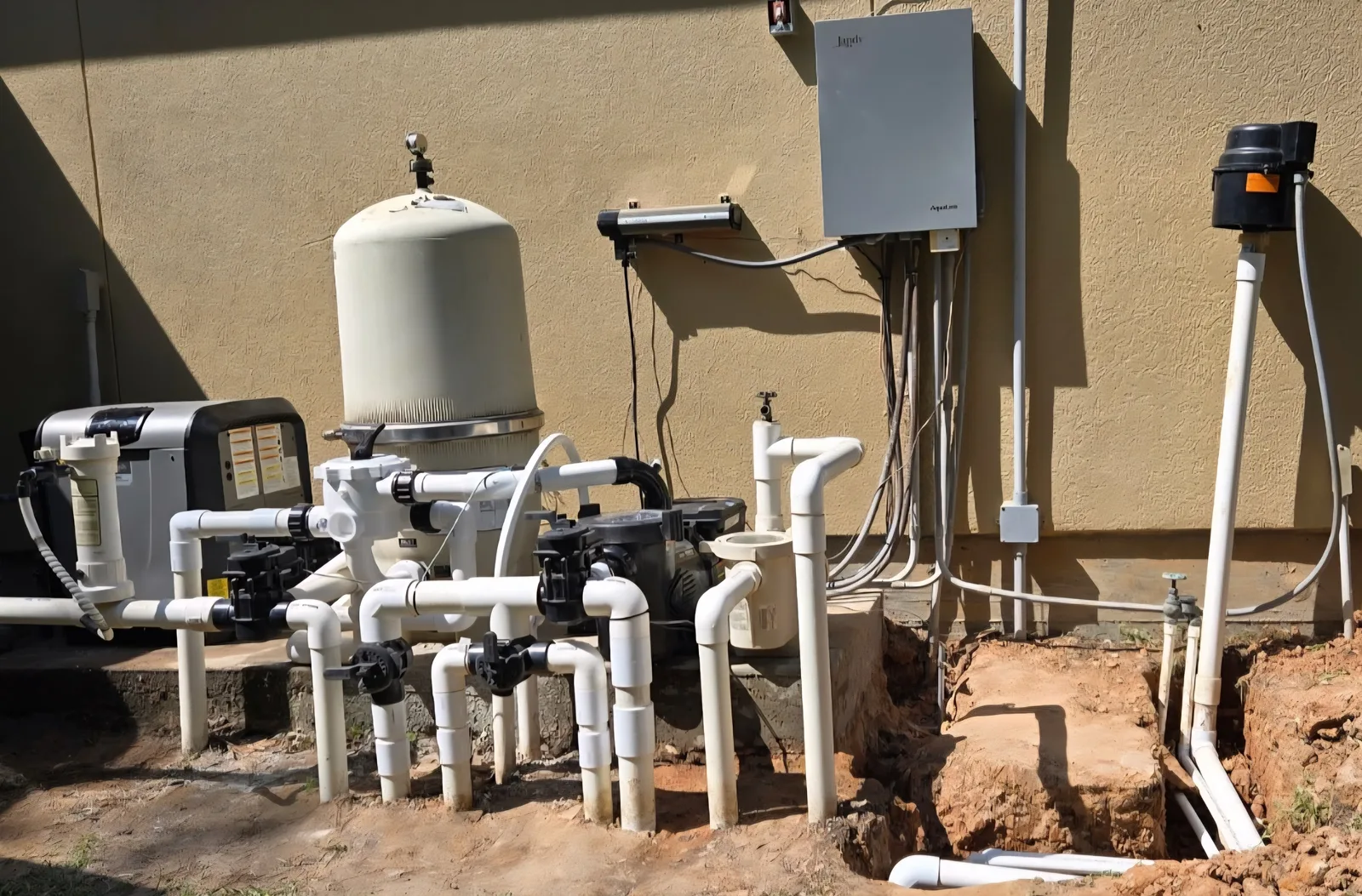
The controller can't communicate with the pump. Jandy says to re-check the RS-485 wiring and the DIP switch address on the pump. On the DV and DVS pumps, switches 3 and 4 must both be OFF with a JEP-R, and the four wires go red, black, yellow, green to pins 1 to 4.
Turn off the main breaker that feeds the pump and wait at least 5 minutes before turning it back on. Jandy says the capacitors must drain completely for the power cycle to clear the error. If the fault comes straight back, there's a cause to find.
On the controller, not the pump. On a JEP-R, the service setup menu has a LAST FAULT screen showing the two most recent unique faults; pressing an arrow key clears that history, so note them first.
It only runs on a command from its controller, during the times programmed into it. Check the schedule first. After that, Jandy lists no power to the motor, a motor error, damaged RS-485 wiring and wrong DIP switch settings.
Jandy's first suspect is debris jammed between the impeller and the diffuser, which stops the shaft turning. A technician checks it with the power off. If there's a lot of debris, check the strainer basket for cracks.
At the default priming speed of 2,750 RPM, about 15 minutes when the pump sits 10 feet above the water; at 3,450 RPM, within 8 minutes. If it won't prime, Jandy says to look for a suction leak.
Tell us what the controller says and what the pump does. If it's the schedule or a setting, we'll tell you so; if it's the wiring, the drive or something jammed inside, we'll come out and fix it. Licensed, insured, serving Cypress and Greater Houston.